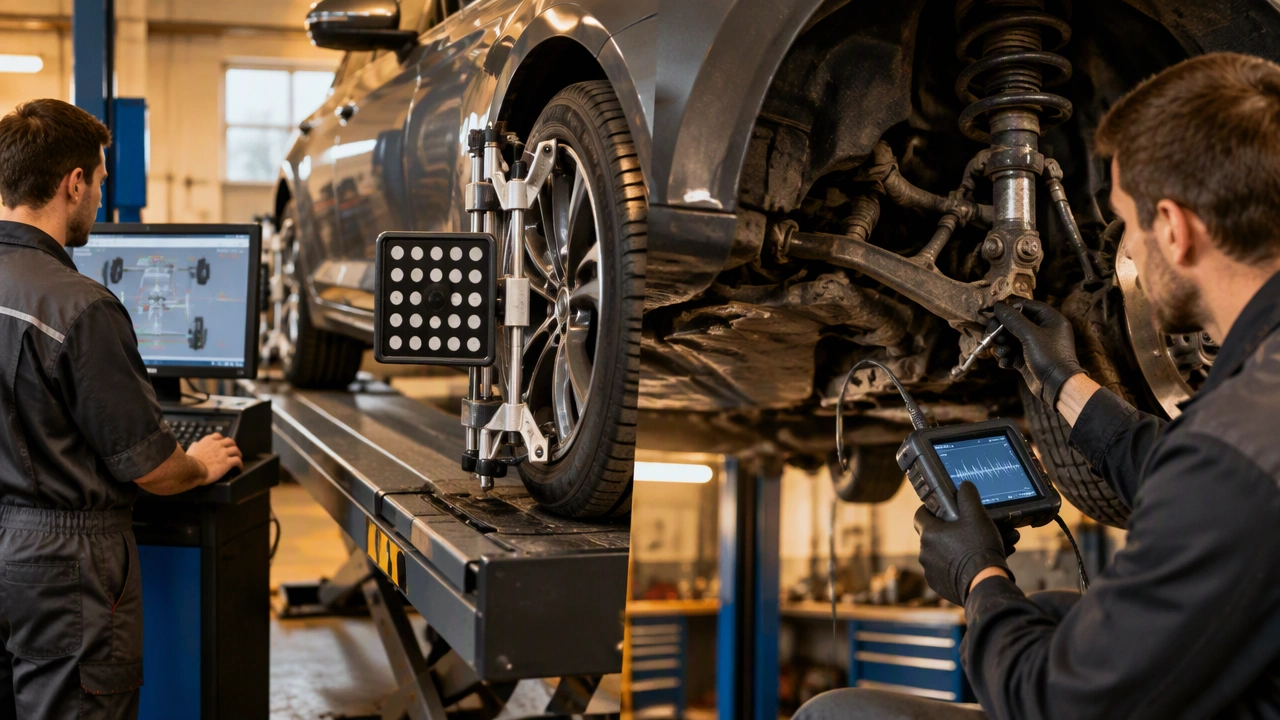
Home / Brakes, Suspension & Steering
How Wheel Alignment Is Measured and How Suspension Knocks and Vibrations Are Traced in the Workshop
When a car pulls to one side, wears tires unevenly, or develops a dull knock over bumps, the workshop looks at two closely related systems: steering geometry and suspension. Understanding how technicians approach wheel alignment measurement and suspension noise diagnosis helps drivers see why these checks are methodical rather than guesswork, and why a proper car repair starts with measurement before any parts are replaced.
What Wheel Alignment Actually Measures
Wheel alignment does not refer to adjusting the wheels themselves, but to correcting the angles at which they contact the road and pivot when steering. Even small deviations, measured in fractions of a degree, affect straight-line stability, cornering response, and tire life. A workshop measures alignment to compare the current geometry against manufacturer specifications for that exact model, engine, and suspension variant, not against a universal standard.
The Three Primary Angles
- Camber: The inward or outward tilt of the wheel when viewed from the front. Excessive negative or positive camber concentrates load on one edge of the tire and can indicate a bent knuckle, worn bearing, or sagging spring.
- Toe: Whether the fronts of the wheels point slightly toward or away from each other when viewed from above. Toe is the most sensitive angle for tire wear; a small error causes rapid feathering and increased fuel consumption.
- Caster: The forward or backward tilt of the steering axis when viewed from the side. Caster affects self-centering and straight-line stability and is felt as light or heavy steering and a tendency to wander.
Beyond these three, the workshop also checks thrust angle, which compares the direction of the rear axle to the vehicle centerline. A thrust angle error means the rear axle steers the car slightly sideways, forcing the driver to hold the wheel off-center even when front toe is correct.
How Wheel Alignment Measurement Is Performed in the Workshop
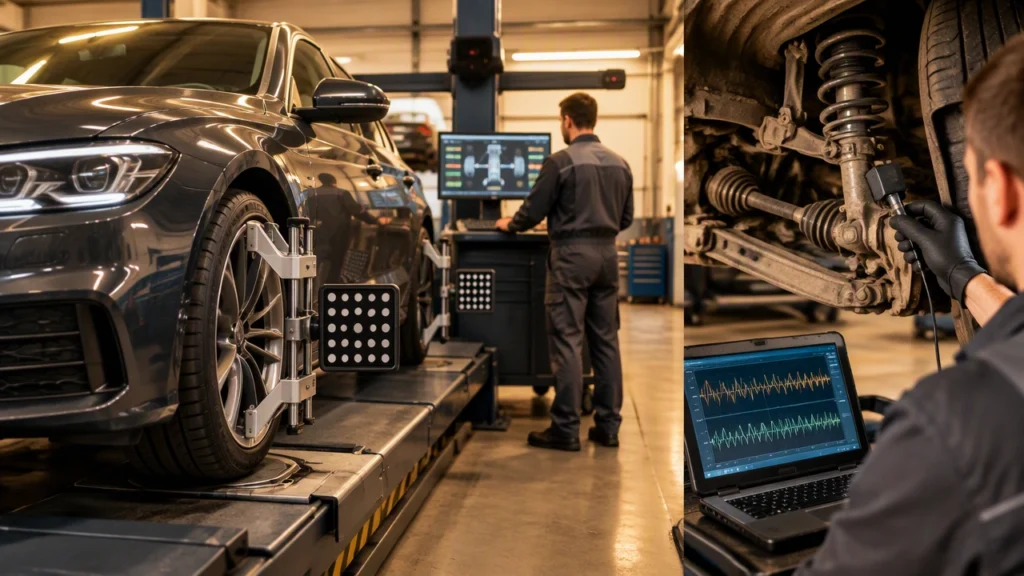
Modern wheel alignment measurement is done on a level alignment bay with a 3D or CCD measurement system. The process is deliberately standardized so results are repeatable regardless of which technician operates the equipment.
- Preparation and tire check: Tire pressures are corrected to specification, tire sizes are verified, and obvious play in wheel bearings or tie rod ends is checked. Measuring with underinflated tires or loose joints produces misleading numbers.
- Vehicle leveling and target mounting: The car is placed on turn plates and slip plates that let the suspension settle without binding. Clamps with reflective targets are attached to each wheel and compensated for rim runout.
- Live measurement and comparison: Cameras read each target in three dimensions and calculate camber, caster, toe, and thrust angle in real time. Values are shown as within tolerance or out of tolerance against the manufacturer database.
- Adjustment: If angles are out of specification, the technician adjusts them where the design allows. Front toe is set via tie rods, rear toe and camber via eccentric bolts or shims, while caster is often not adjustable on many models.
- Road test and printout: A short road test verifies that the steering wheel is centered and the car tracks straight. The final before-and-after printout documents the values for the customer and workshop records.
Accurate measurement depends on a calibrated rig and a truly level floor. A workshop that maintains its equipment calibrates cameras regularly and checks lift level, because an uneven surface can introduce a false camber reading.
How Suspension Knocks and Vibrations Are Traced
While alignment is about angles, suspension noise diagnosis is about movement and contact. Knocks, clunks, creaks, and vibrations each point to different types of play or friction, and a good diagnosis separates what the driver hears from what the suspension actually does.
A Structured Approach to Suspension Noise Diagnosis
Technicians usually follow the same sequence to avoid replacing parts by guesswork:
- Interview and road test: When does the noise occur — over sharp bumps, during slow turning, under braking, or at constant highway speed? A knock at low speed over small bumps suggests anti-roll bar links or bushings, while vibration that grows with speed points to wheel balance or a worn bearing.
- Lift inspection with load and unload: On the lift, the technician rocks each wheel at 12 and 6 o’clock for bearing and ball joint play, and at 3 and 9 o’clock for tie rod play. Bushings are checked for cracked rubber, fluid leaks, and shiny marks from metal contact.
- Isolation with tools: A pry bar gently loads control arms to reveal small bushing play invisible by hand. Electronic chassis ears — clamp-on microphones on suspect parts — let the technician listen while driving and isolate the source.
- Vibration analysis: For vibrations, the workshop checks wheel balance, tire uniformity for flat spots or bulges, brake disc runout for judder when braking, and driveshaft or CV joint condition for vibration under acceleration.
What makes this process reliable is that it is comparative. Left and right sides are always compared, and any play is judged against the opposite side and the manufacturer tolerance, not just by feel. Photos or short videos of the play are often taken to show why a specific part is recommended.
Common Causes Behind Alignment Drift and Suspension Noise
Alignment and noise complaints often share the same root cause. A pothole impact can bend a rim, knock toe out of specification, and crack a bushing that starts knocking weeks later. Normal aging also plays a role, as rubber bushings harden, springs sag slightly, and ball joints develop play over tens of thousands of miles.
- Gradual wear items: Anti-roll bar links, tie rod ends, control arm bushings, and strut top mounts are the most frequent sources of light knocks at low speed. They develop small clearances that become audible when the suspension changes direction.
- Impact damage: Bent wheels, deformed tires, and shifted subframes after hitting a curb or deep pothole. These often show up as a sudden change in steering center or a new vibration.
- Maintenance-related drift: Replacing any suspension or steering component changes geometry. Without a subsequent alignment measurement, the new part may be within its own tolerance but push the total axle geometry out of specification.
When to Recommend Alignment and Noise Checks Together
Workshops often recommend both checks at the same time because the symptoms overlap. Uneven tire wear, a steering wheel that is no longer centered, a pull to one side, or a new knock after an impact are all reasons to measure alignment and inspect the suspension for play. Even without symptoms, many manufacturers suggest checking alignment after suspension work, after winter pothole season, or when new tires are fitted to protect the investment.
A calm, documented approach — measure first, locate the play, then repair and re-measure — saves time and prevents unnecessary part replacement. For the driver, the result is more predictable handling, quieter travel over bumps, and longer tire life.